

When a child has difficulty expressing what they want, need, feel, or want to avoid, everyday situations can become harder for both the child and the people supporting them. Parents may wonder whether ABA therapy can help, especially if their child uses little spoken language or communicates in ways others don’t always understand.
ABA therapy can support communication by identifying what an individual is trying to express and systematically teaching an accessible way to communicate that need. Depending on the individual, this may involve speech, gestures, signs, pictures, AAC, or another functional communication method.
The goal is not necessarily to make a child speak. The more important goal is helping the child communicate meaningful messages in a way that works for them.
Communication can be an important part of an individualized ABA therapy plan.
A child might need support learning how to ask for help, request a favorite item, choose between activities, indicate that something hurts, ask for a break, reject something they do not want, or let another person know they are finished.
ABA professionals can look at situations where communication becomes difficult, identify patterns in the child’s behavior, and teach a more accessible response that lets the child express the same need.
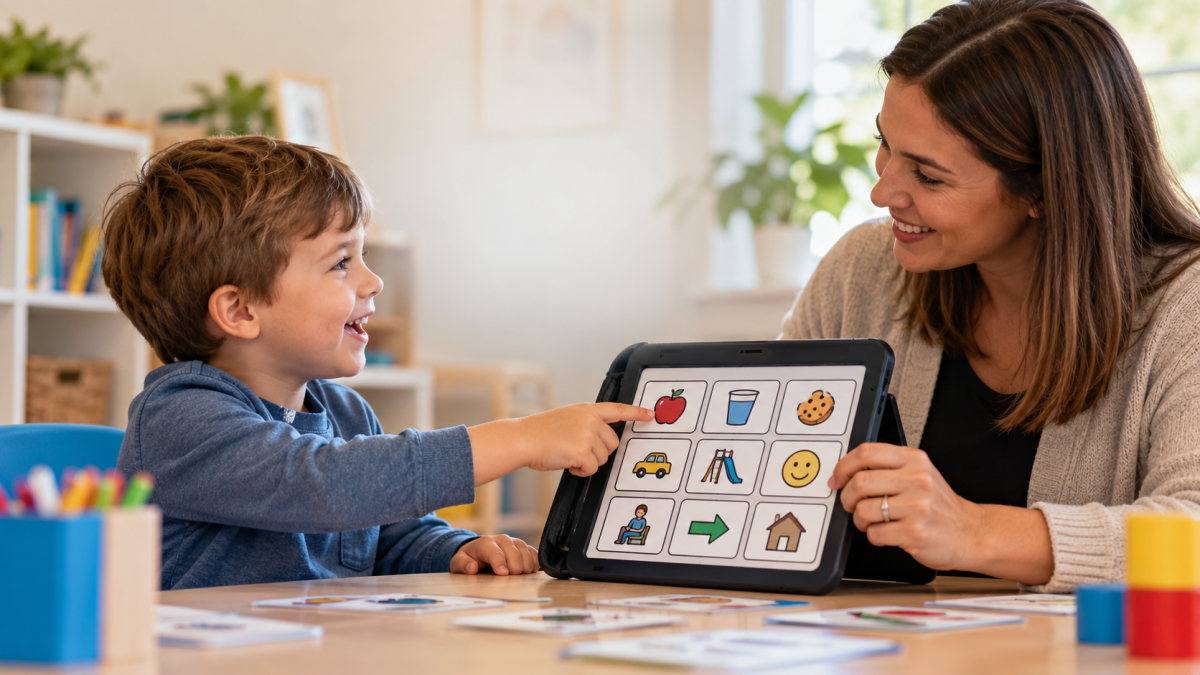
What that response looks like should depend on the individual. For one child, it might be a spoken word. For another, it could be pointing, signing, choosing a picture, or selecting a message on an AAC device.
One of the most important distinctions for families to understand is that communication and speech are not the same thing.
Speech is one way people communicate, but it is not the only way.
A person may communicate through spoken words, facial expressions, body movements, gestures, signs, pictures, written language, communication boards, or electronic AAC systems. Some people use several communication methods depending on the situation.
The American Speech-Language-Hearing Association describes AAC as communication that supplements existing speech or serves as an alternative when spoken communication does not meet someone’s needs. AAC can include gestures, manual signs, pictures, communication boards, and speech-generating devices.
For that reason, success in ABA therapy for communication should not be measured only by whether a child begins speaking more. A meaningful outcome may be that the child has a reliable way to say, “help,” “stop,” “I want that,” “I need a break,” or “something is wrong.”
Parents sometimes hear the phrase “behavior is communication.” That phrase reflects an important idea, but it shouldn’t be oversimplified.
Not every behavior is an intentional message. ABA professionals instead look for patterns in what happens before and after a behavior to understand what function that behavior may be serving.
Imagine a child who regularly cries, pushes materials away, or drops to the floor during a difficult task. The behavior could have several possible explanations. The child may be trying to get away from the activity, ask for assistance, respond to discomfort, or communicate another need.
Rather than assuming why the behavior is occurring, a behavior professional can gather information about when it happens, what happens immediately before it, and what happens afterward.
If the assessment suggests the child is using behavior to get help or a break, the next step may be to teach a clearer, easier way to communicate that same need.
For families who want to understand this process more deeply, a functional behavior assessment examines the circumstances surrounding a behavior and helps guide individualized support.
Functional Communication Training, often shortened to FCT, is a behavior-based approach for teaching a communication response that serves the same function as a behavior that is causing difficulty.
For example, suppose a child frequently screams when they cannot open a container. Assessment suggests that screaming has reliably resulted in an adult opening it.
Instead of focusing only on stopping the screaming, Functional Communication Training may teach the child a more direct way to request assistance.
Depending on the child’s existing skills, that response could be saying “help,” signing for help, handing an adult a picture, pointing to a help symbol, or choosing “help” on an AAC device.
FCT research emphasizes identifying the function of the behavior first, then selecting a communication response that is recognizable, accessible, and reasonably easy for the person to use.
Communication responses studied in FCT have included speech, signs, picture exchanges, gestures, and voice or text-output devices.
The specific form matters because a replacement response is only useful if the child can actually use it when the need occurs.
Functional communication can involve much more than asking for a preferred toy or snack. Depending on the individual’s needs and treatment goals, communication skills may include:
These skills can matter at home, at school, during community activities, and in other everyday settings.
A person-centered plan should prioritize communication that makes the child’s daily life more manageable and gives them greater ability to express preferences and needs.
ABA can teach functional communication without making spoken language the required outcome.
A nonspeaking or minimally speaking autistic child may communicate effectively through gestures, signs, pictures, an AAC system, or a combination of methods. The communication method selected for teaching should reflect the child’s abilities, existing communication system, preferences, and support needs.
Collaboration may also be valuable here. Speech-language pathologists have specific expertise in speech, language, and AAC.
At the same time, ABA professionals may focus on teaching the child to use a functional communication response when needed.
A child’s care should not depend on forcing one communication method when another is more accessible.
AAC stands for augmentative and alternative communication. It includes a wide range of communication approaches, from gestures and picture boards to apps and speech-generating devices.
A child does not need to be completely nonspeaking to use AAC. AAC may supplement spoken communication, serve as a person’s primary communication system, or be used differently depending on the setting. ASHA also notes that no specific prerequisite skills must be demonstrated before considering AAC.
If a child already uses AAC, ABA goals can incorporate that communication method rather than requiring a verbal response.
For example, if the child is learning to request a break during a difficult activity, the relevant response might be selecting “break” on their device. Therapy can then give the child repeated opportunities to learn that using their communication system produces an understandable and useful response from the people around them.
Consistency matters too. Families, behavior professionals, speech-language pathologists, educators, and other members of the child’s support team may need to coordinate so that the communication method remains available and meaningful across settings.
Imagine knowing exactly what you need but not having a reliable way to make another person understand.
Communication difficulties can contribute to frustration, particularly when a child has learned that crying, grabbing, yelling, leaving an activity, or another behavior gets a faster response than their available communication method.
Functional communication changes that equation by giving the child another option.
If asking for help is easier and more effective than becoming increasingly upset, the child has a reason to use the communication response again. With practice, that response can become part of everyday routines.
FCT has a strong research base for increasing functional replacement communication and reducing certain challenging behaviors when the intervention matches the behavior’s function. Results still depend on the individual, implementation, setting, and other factors, so families should not expect identical outcomes for every child.
The purpose is not to suppress every expression of frustration. Children are allowed to be frustrated, refuse, disagree, and express discomfort. The goal is to make sure they also have an effective way to communicate what they need.
ABA therapy should not be described as a guarantee that a child will develop spoken language.
Some ABA programs may work on verbal communication when speech is already an appropriate and accessible communication method for that individual. For another child, a gesture, sign, picture system, or AAC device may be more functional.
ABA therapy is also not the same service as speech-language therapy. The two disciplines can address overlapping communication goals from different areas of expertise, and collaboration may be appropriate when a child receives both services.
For families, the better question is often not simply, “Will ABA make my child talk?”
A more useful question is, “How will this therapy help my child communicate what matters to them?”
Communication goals should be individualized rather than taken from a standard checklist.
Before choosing treatment goals, the therapy team should understand how the child currently communicates, which situations are difficult, what the family observes at home, and which communication skills would make the greatest practical difference.
A child who cannot easily ask for help may need a different goal from a child who can request objects but has difficulty communicating “no,” “stop,” or “I need a break.”
Families can ask questions such as:
Those questions help keep therapy focused on useful communication rather than simply completing tasks during sessions.
Communication support should give a child more effective ways to participate in their own life.
That includes asking for things they enjoy, but it also includes refusing, requesting help, expressing discomfort, choosing between options, asking for space, and telling another person when they are finished.
The goal is not to make every child communicate in the same way. It is to help each child develop communication that is accessible, understandable, and useful in the situations that matter to them.
Linx Community Services takes a people-focused approach to supporting individuals with intellectual and developmental disabilities and for families in West Virginia exploring ABA therapy for communication, understanding how communication goals are selected and individualized is an important part of deciding whether a provider’s approach fits their child’s needs. Linx’s current ABA program includes communication among the areas that may be addressed through individualized treatment.
If you have questions about ABA therapy, communication goals, or current eligibility requirements, you can contact Linx Community Services to learn more about available services and next steps.
