

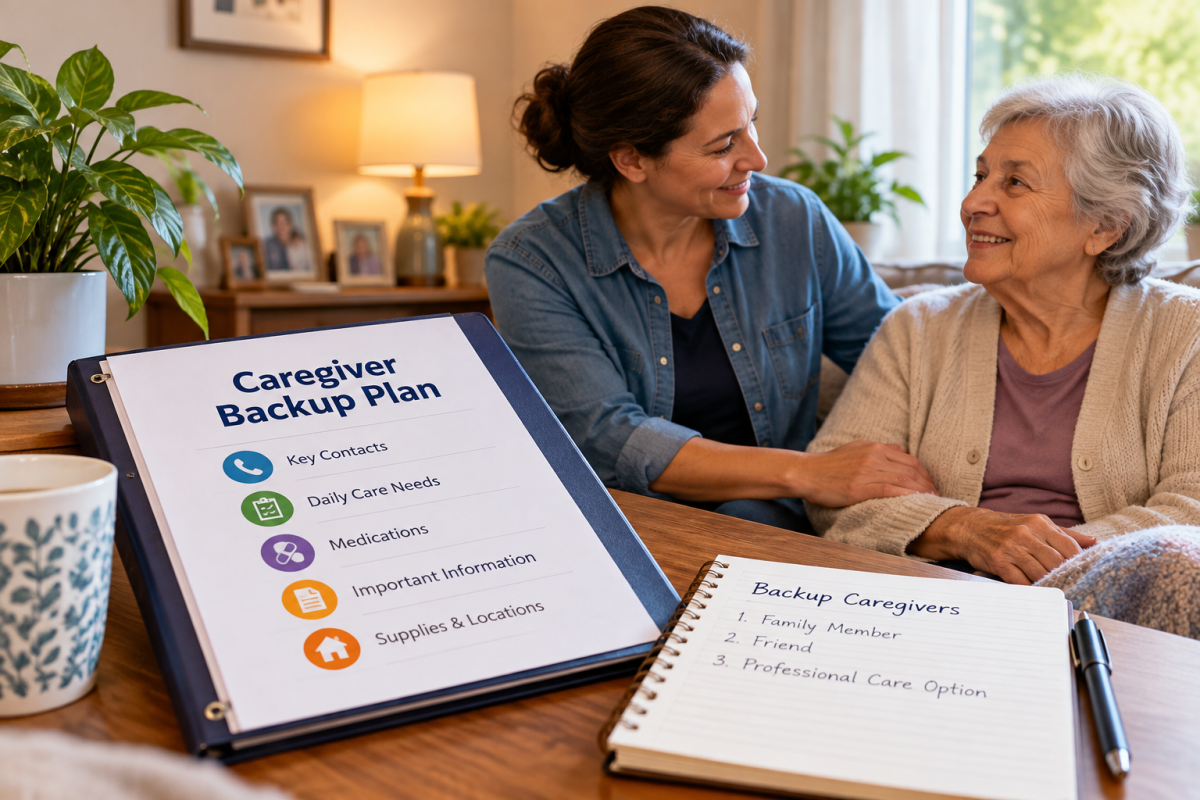
If you could not provide care tomorrow, would someone else know what to do?
For many family caregivers, that question is difficult to answer. You may know when your parent takes medication, how much help they need to get dressed, which foods they will eat, when they tend to get tired, and what usually helps when they become anxious or confused. Much of that information may exist only in your memory.
That can become a problem if you wake up sick, need medical care yourself, have an unexpected work obligation, experience a transportation problem, or need time away from caregiving.
A caregiver backup plan gives another trusted person the information they need to continue essential care when you are temporarily unavailable. It identifies who can step in, what they need to know, and what should happen if your first backup option cannot help.
Creating one does not mean preparing for the worst. It means recognizing that schedules change, caregivers get sick, and unexpected situations occur.
You also don’t have to document every detail of your loved one’s life. A useful backup plan focuses on the information another person needs to manage a normal day safely and respectfully, without depending on you for every decision.
A caregiver backup plan is a written, practical plan that identifies who can provide care if the primary caregiver becomes unavailable, what the care recipient needs, and where to find important information and supplies.
The plan can help with both unexpected and planned absences.
Unexpected situations might include:
Planned situations may include:
A backup plan does not have to be a complicated legal or medical document. Its purpose is practical. If another person suddenly needed to step in, they should be able to answer three basic questions:
The plan’s complexity should reflect the level of care your loved one needs. Someone who primarily needs help with meals and transportation may need a much simpler plan than a person who requires mobility assistance, regular supervision, or help with personal care.
Start with what another caregiver would need to get through one typical day. Add information as you identify gaps.
If you are the only regular caregiver, plan for the first few hours of an unexpected absence. Identify the first person you would contact, determine what they can safely do, and have another option if they are unavailable.
Consider a simple scenario.
You wake up at 6 a.m. with a fever and realize you cannot safely help your father transfer out of bed. He cannot remain alone for the morning.
What happens next?
Your backup plan should make the next several decisions easier.
Who receives the first phone call? Can that person arrive soon enough? Do they understand how much assistance your father needs? Do they know his morning routine? Can they safely perform the tasks involved?
Then comes another important question: what happens if they cannot come?
A plan containing only one person’s name may leave you in essentially the same position if that person is working, traveling, sick, caring for children, or otherwise unavailable.
Instead, consider three layers of support:
Primary backup: The first person you would normally contact.
Secondary backup: Another person who can step in if your first choice is unavailable.
Professional or community option: A service or program that may be appropriate when friends or relatives cannot meet the need.
Your backup options don’t need to provide the same type of help. One person might be able to stay with your parent while another handles transportation or errands.
The important part is deciding what happens before you are trying to solve the problem while you are sick, at the hospital, or handling another emergency.
Your backup caregiver should be someone who can realistically handle the responsibilities you are asking them to take on. Depending on your circumstances, support might come from relatives, friends, neighbors, professional caregivers, respite providers, adult day programs, or community resources.
Don’t start by asking, “Who can replace me?”
That question can make backup planning seem more difficult than it needs to be.
Instead, list what you actually do.
You might help with:
Then decide who could realistically handle each responsibility.
For example:
Your sister may be comfortable staying with Mom for several hours but may not be able to provide certain hands-on personal-care tasks.
A nearby neighbor may be able to bring in groceries or stay briefly while another caregiver is on the way.
Your son may be able to provide transportation to appointments.
Another relative may live several hours away but can still manage scheduling or communicate with providers by phone.
A professional caregiver may be appropriate for specific personal-care needs.
This is why a backup plan can work better as a network than as an attempt to find one person who does everything.
Consider organizing support into three categories.
This is the first person you would normally contact when you cannot provide care.
Be specific about what you are asking. Someone who agrees to “help if you ever need anything” may have a different idea of help than someone who has agreed to stay with your parent for four hours.
Choose another person or option in case your primary backup is unavailable.
Ask about realistic limitations, including work schedules, transportation, physical ability, childcare responsibilities, and distance.
Identify people who can take responsibility for individual needs such as meals, transportation, errands, pet care, paperwork, or appointment management.
Dividing the work can make a backup plan more practical for families with different schedules and abilities.
Another caregiver needs enough information to manage your loved one’s normal routine safely without guessing or contacting you for every detail. Focus on what happens during a typical day, where important items are located, and which routines or preferences affect care.
Start with the day from beginning to end.
Include information such as:
Explain the basics surrounding:
Document:
The key is to be specific enough to be useful.
An instruction like “Mom needs help getting ready” leaves several questions unanswered.
A more useful version might be:
“Mom usually wakes between 7:00 and 7:30. Give her a few minutes before asking her to stand. Her walker should be beside the bed. She usually uses the bathroom before getting dressed.”
That tells the backup caregiver what typically happens and what they should expect.
You do not need to document every preference or every variation that has occurred over the years. Ask yourself what another person would need to know to manage an ordinary day without repeatedly calling you.
It can also help to walk through the routine with your backup caregiver rather than relying entirely on written instructions.
Show them where supplies are kept. Explain how the day usually flows. Point out which tasks require more assistance and which ones your loved one can manage independently.
Written information works best when the backup caregiver is familiar with the routine before an emergency occurs.
A backup caregiver should be able to locate an accurate, current summary of the medical information relevant to the established care routine. That may include medications, allergies, healthcare providers, mobility restrictions, emergency contacts, and other instructions already used in your loved one’s care.
Your information sheet may include:
Keep this information consistent with the person’s established medical and care plan.
A substitute caregiver should not independently decide to change medication dosages, medication timing, mobility procedures, clinical routines, or supervision requirements. The backup plan communicates existing instructions accurately.
It is also important to keep the information current. An old medication list can create confusion if the person using it assumes that it still reflects the current routine. When medication, provider, or care information changes, update the backup copy along with the version you use regularly.
Decide where to store the information and who should have access to it.
Protect it appropriately because medical information is sensitive, but an emergency document that no one can find or access isn’t very useful.
No backup caregiver will know your loved one exactly as you do, and they do not need to. The goal is to communicate the routines, preferences, behavioral patterns, and warning signs that help someone provide safe, familiar care.
Long-term caregivers often develop knowledge that would never appear on a medication list or medical summary.
You may know that Dad says he is not hungry when he actually wants a simple snack.
You may know that Mom becomes anxious when someone asks several questions at once.
Perhaps evenings are more difficult, a particular chair makes standing easier, or a familiar television program helps your loved one settle into an evening routine.
Those details matter because they can make temporary care less confusing for both the caregiver and the person receiving care.
Consider documenting four categories of information:
How does your loved one prefer to be addressed? Do they need extra time to answer questions? Does hearing impairment, memory loss, or another communication difficulty affect conversations?
Are there certain times of day when your loved one tends to become more tired, anxious, confused, or frustrated?
What changes would stand out to you because they are unusual for this person?
Document observations and existing instructions rather than attempting to create medical guidance for the substitute caregiver.
Does rushing increase anxiety? Does a familiar routine help? Are there activities, music, photographs, television programs, or conversational topics that tend to provide comfort?
Your goal is not to train someone to become an exact copy of you.
It is to transfer enough of your practical knowledge that another trusted person can provide care in a way that remains safe, respectful, and reasonably familiar.
A backup caregiver should understand the safety requirements that are already part of your loved one’s normal care. Written instructions should explain not only what equipment or risks exist, but how they affect the person’s routine.
Relevant information may involve:
Specificity matters.
“Dad uses a walker” provides basic information.
“Dad should use his walker whenever he leaves the chair, and someone normally stays nearby because he becomes unsteady when turning” explains how the walker fits into his established routine.
The backup plan should accurately communicate existing care and safety requirements rather than asking another caregiver to make independent medical decisions.
If a task requires training or physical skills that a potential backup caregiver does not have, acknowledge that limitation. That person may still be useful for another part of the backup network.
A caregiver binder, folder, or secure digital equivalent can be useful when it gives trusted caregivers one predictable place to find important information. The format matters less than keeping the information organized, current, and accessible to the appropriate people.
Possible sections include:
Your binder can also explain where practical items are located.
For example:
Think about what someone would have trouble locating if you were not available to answer questions.
You may prefer a physical binder at home, a digital file, or a combination of both. Choose a system your backup network can actually use.
Because some of this material may include private medical or personal information, consider how it is protected. At the same time, make sure the appropriate backup caregiver knows how to access essential information when needed.
If your parent or loved one resists backup care, try introducing another caregiver gradually rather than waiting until an emergency forces an unfamiliar arrangement. Resistance may stem from privacy concerns, independence, embarrassment, confusion, fear of strangers, or past negative experiences.
Simply telling someone they need to accept help may not address why they feel uncomfortable.
Where appropriate, make the new person familiar before they need to provide care independently.
A gradual introduction could look like this:
How you describe the arrangement may also matter.
“You need someone else to take care of you” can sound as though you’re imposing a major, permanent change.
A more specific explanation may be easier to understand:
“Sarah is going to stay with you while I go to my appointment. I’ll be back after lunch.”
The goal is not to mislead the person receiving care. It is to explain what is happening clearly and in a manageable way.
If your loved one’s resistance is connected to confusion, dementia, complex behavioral concerns, or other care needs, the appropriate approach may depend on the person’s established care plan and circumstances.
The key is to avoid making the first introduction during a crisis whenever possible.
A caregiver backup plan does not have to depend on relatives. If family members are unavailable, live far away, cannot safely provide care, or have strained relationships, your backup network may combine friends, neighbors, professional services, community programs, and remote family support.
Some caregivers have no nearby relatives. Others have siblings or adult children who want to help but cannot provide hands-on care. Some relatives may be unreliable. Others may have their own health, work, transportation, or caregiving responsibilities.
A practical plan has to account for the support you actually have, not the support you wish were available.
Depending on your situation, potential resources may include:
A distributed plan may be more realistic than searching for one person to replace you.
For example, a professional caregiver could handle personal care. A trusted neighbor might be willing to stay for a short period during an unexpected situation. A friend could pick up groceries. An adult child living elsewhere could manage appointments or calls remotely.
This arrangement recognizes that caregiving involves many separate responsibilities.
It also gives people a way to help within their actual abilities. Someone who cannot safely assist with mobility may still handle errands. Someone who lives several hours away may still be able to organize schedules, communicate with family members, or coordinate appointments.
A backup plan can be a network, not a single replacement caregiver.
Build more than one layer into your backup plan. Your first backup caregiver can become unavailable for many of the same reasons you can, so identify a second option and consider what could provide temporary coverage while you make another arrangement.
Your plan might look something like this:
Your sister stays with Mom.
Use a professional respite provider when available and appropriate.
An adult day program provides another option when available and appropriate.
A trusted neighbor can stay temporarily while you coordinate another arrangement.
Your options will depend on your loved one’s needs and the resources available to you. The important principle is redundancy.
When you discuss backup care with friends or relatives, ask what they can realistically commit to.
“Call me anytime” sounds reassuring, but it does not necessarily mean someone can leave work without notice, provide hands-on personal care, stay overnight, or supervise someone for several hours.
Specific conversations lead to more useful plans.
Ask what days and times they are generally available. Ask which tasks they are comfortable performing. Discuss transportation and other practical limitations.
A realistic “I can help with these two things” is more valuable than a vague promise that may not work when you need it.
Test your backup plan before depending on it during an emergency. A short trial period can reveal missing information, unclear instructions, practical limitations, and parts of the routine your backup caregiver does not yet understand.
Start while you are still available.
Have the backup caregiver participate in a normal routine while you remain nearby. Show them where supplies, medications, meals, mobility devices, and emergency information are kept.
When everyone is comfortable, try leaving for a short period.
You could:
Afterward, ask what was unclear.
A trial run can also reveal that your original backup arrangement is not practical. That information is useful. It allows you to adjust responsibilities or find another option before the situation becomes urgent.
Test a caregiver backup plan before you depend on it during an emergency.
Review your caregiver backup plan whenever your loved one’s care needs, medical information, routine, or available support changes. Also periodically confirm that contact information and backup caregiver availability are still accurate.
Update the plan after changes such as:
Even if the person’s needs remain relatively stable, check the practical details from time to time.
Has a backup caregiver changed jobs? Has someone moved? Can the neighbor you planned to call still help? Are the phone numbers in your emergency contact list up to date?
A plan is useful only if it reflects your current situation.
Your caregiver backup plan should give another trusted person enough information to manage an ordinary period of care without relying on you for every decision.
Include:
Then ask someone in your backup network to review the information.
If another trusted person could use this information to safely manage a normal day without relying on you for every decision, your backup plan is becoming useful.
Most family caregivers do not know in advance when an illness, work obligation, transportation problem, or family emergency will make them temporarily unavailable.
That is why backup planning is most useful before the situation becomes urgent.
You do not need to solve every possible caregiving problem in one afternoon. Start by answering three questions:
Then take one action today.
Call a potential backup caregiver. Write down tomorrow morning’s routine. Update the medication list you already use. Create one emergency contact page. Schedule a short trial visit.
Each step makes your loved one’s care less dependent on one person holding all of the information and responsibility.
Not every family has relatives or friends who are available or able to provide backup care. Other families may have a strong support network but still need assistance during work hours, appointments, caregiver rest, or unexpected schedule changes.
Professional respite or in-home support can be one part of a broader backup plan rather than a replacement for family involvement.
If your current network cannot reliably cover all of your loved one’s care needs, Linx Community Services may be a resource to consider as you explore additional support options.
The goal is to create a plan that reflects your family’s actual circumstances and gives you another option when your usual caregiving routine cannot continue.
A caregiver backup plan identifies who can provide care when the primary caregiver is unavailable, explains the care recipient’s essential routines and needs, and tells the backup caregiver where to find important information and supplies. A useful plan usually includes more than one potential source of support, so care doesn’t depend on a single person’s availability.
Include emergency contacts, backup caregiver information, the normal daily routine, current medications, allergies, healthcare providers, mobility and personal-care needs, dietary requirements, safety concerns, and the locations of medications, equipment, supplies, and essential documents. Include only information that is current and relevant to providing the person’s established care.
The backup plan should already define the first step. Contact the primary backup caregiver and explain what coverage is needed. If that person is unavailable, move to the secondary backup or another planned professional or community option. Preparing these contacts and instructions in advance reduces the number of decisions that have to be made while the primary caregiver is ill.
The primary caregiver should keep an accessible copy, and the trusted people expected to provide backup care should know where to find the information they need. Because a plan may contain private medical and personal information, limit access appropriately while still allowing the right person to reach essential information during an emergency.
Leave enough information for the person to understand the normal routine, medication schedule according to the established plan, meals, mobility needs, personal-care needs, supervision requirements, communication preferences, safety concerns, emergency contacts, and locations of supplies and equipment. Include practical details that would otherwise require the caregiver to call you and ask what to do.
Introduce the person gradually when possible. Begin with social visits or time together while you remain present. The backup caregiver can then help with one familiar task before you leave for a short period. Resistance may have several causes, including privacy concerns, embarrassment, fear of strangers, confusion, or a desire to remain independent, so the approach should reflect the individual’s circumstances.
Consider building a network that combines several types of support. Friends, neighbors, professional respite providers, in-home caregivers, adult day programs, social workers, aging resources, disability organizations, community programs, and other appropriate resources may all play a role. One person doesn’t have to handle every caregiving responsibility.
A caregiver binder can be useful if it gives trusted backup caregivers one place to find current information. You can also use a secure digital system. Organize information by category, such as emergency contacts, routine, medications, healthcare providers, appointments, meals, mobility needs, household information, and backup contacts.
Update the plan whenever medications, mobility, medical equipment, diet, providers, routines, safety concerns, emergency contacts, or caregiver availability change. Periodically verify phone numbers and availability even if your loved one’s care needs remain the same.
Conduct a trial run. Have the backup caregiver participate in a normal part of the routine, find necessary supplies and information, and provide care for a short period. Afterward, ask what information was missing, which instructions were unclear, and whether any tasks were outside their abilities. Use what you learn to revise the plan before you need it unexpectedly.
